Foundry
Published by Admin on September 25, 2026
Foundry
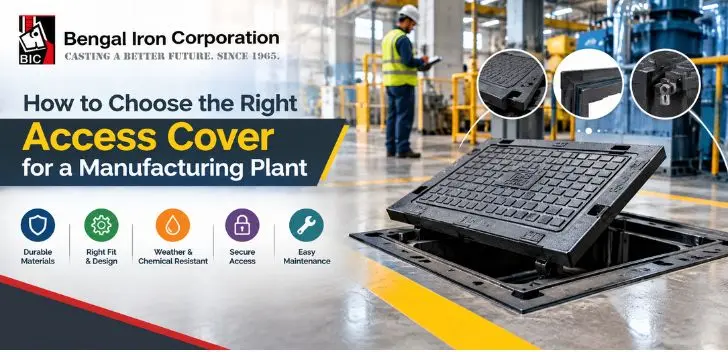
A casting defect in an access cover may not be a big deal, but in a manufacturing plant, it can very quickly result in things like broken hinges and out-of-place frames. Precision is essential in a cast iron foundry in India, where metals are melted and cast into sand moulds, and that should definitely be a consideration when you make your decision. Cooling rate is something that foundry engineers have to consider to maintain strength, and the same should go for plant managers when evaluating weight-bearing capacity.
The process of choosing an ideal traffic cover starts with determining the type of traffic: use ductile iron for heavy-duty traffic because of its sturdiness, whereas other forms will suit light-duty traffic. Take into account the design of the cover, whether it is recessed or flush, bolted or hinged. Think about the sealing systems in case there are liquids and high temperatures. Get a cover which makes it easy to maintain.
Your access hatch is the unsung hero of your plant floor, supporting tons of traffic daily while concealing important utilities. However, choosing the wrong hatch can turn it into a safety hazard.
Grey cast iron has high compressive strength but is inexpensive compared to ductile iron (otherwise known as nodular or spheroidal graphite iron) in regard to its tensile strength and shock resistance. Ductile iron is best suited for heavy traffic areas due to its high tensile strength and elongation ability. A DI manhole cover can endure an impact load which would break grey iron.
Think about temperature variations, spills, humidity, and wash down procedures. Regular cast iron coverings function fine under normal weathering conditions, but if you have a plant that is using chemicals such as acids, alkalis, or salt water, choose galvanised or stainless steel coating on your covers. In a food or drug processing plant, there is a need for smooth, non-porous surfaces.
Transporting cast iron covers, which are bulky items, over a considerable distance is an expensive venture with regard to logistics costs. Do not decide without searching for local suppliers first. All you need to do is make an Internet search using the key phrase “manhole cover near you.” This will help you find reliable local suppliers with shorter shipping times and other advantages.
The frame itself is just as important as the lid. Search for a deep groove cut into the material to guarantee a tight fit and no rattling when in use. The seat should be moulded to create a dust- and waterproof seal, crucial for plants that experience fine particles or any kind of runoff. Don’t settle for flat frames, which will collect dirt and become stuck.
Unauthorised access to the underground utility can be risky. Covers that are fitted with tamperproof locking systems such as locking bolts, lock systems, or padlocks should be selected. Where security is an issue, it may be wise to consider covers that have some form of smart access control.
In picking the correct access cover, all one needs is to ensure harmony between the realities of the plant and the right quality of materials and design. One just needs to ensure that the material is durable, adaptable to the environment, and user-friendly. This should not be seen as a cost but as an investment.
25 Sep 2026 by Admin
21 Sep 2026 by Admin
17 Sep 2026 by Admin
15 Sep 2026 by Admin
07 Sep 2026 by Admin
3989 Pipes (1)
Access Covers (8)
Agricultural (5)
BIC Events (9)
Cast Iron (103)
Cast Iron Exporter (36)
Cast Iron Gratings (2)
Cast Iron Pipe (26)
Cast Iron Pipe Fittings (24)
Cast Iron Products (79)
Drain Cover (6)
Ductile Iron (40)
Ductile Iron Manufacturers (24)
Ductile Iron Products (41)
Foundry (6)
Global Market (2)
Gray Iron Exporter (3)
Hubless Pipe (13)
Hubless Pipes (21)
Inspection Covers (4)
Iron Foundry (8)
Manhole Covers (179)
Manhole Covers Manufacturer (65)
Pig Iron (2)
Recessed Chamber Cover (2)
Uncategorized (3)
Uncategorized (3)
Enquire Now




