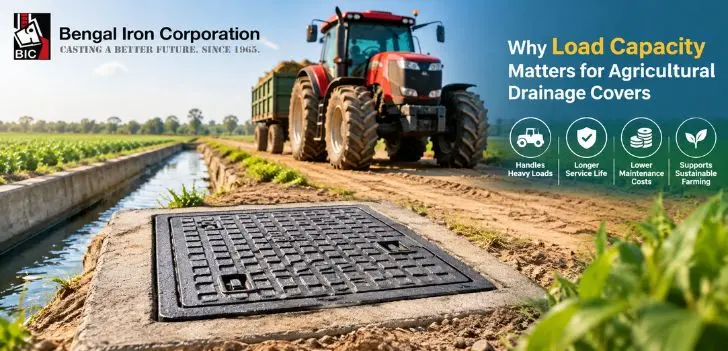
Why Load Capacity Matters for Agricultural Drainage Covers

A successful agricultural environment depends on more than fertile soil, healthy crop rotation, and adequate rainfall. Beneath the agricultural land, durable, reliable drainage channels, irrigation pipelines, inspection chambers, and underground utilities help farms operate efficiently. These systems need to remain accessible for regular inspection and maintenance, and agricultural drainage covers play an important role.

When a tractor crosses a farm access road after heavy rain, it requires a robust surface. Beneath its wheels, a durable drainage chamber cover can withstand heavy loads. Without durability, the drainage cover may crack, shift, or be damaged, disrupting regular farm operations. That’s why load capacity is vital when choosing agricultural casting. The right drainage covers can withstand loads and support smooth agricultural operations.

Now let’s explore this blog to ascertain why load capacity matters for agricultural drainage covers.

Why Load Capacity Is Essential for Agricultural Drainage Covers

If the agricultural industry wants to know why load capacity is essential when choosing agricultural drainage covers, this section can help.

1. Agricultural sites face more than one type of load

A drainage cover installed beside an irrigation channel may experience very different conditions from one positioned on a road connecting two sections of a farm. Farm vehicles such as tractors and agricultural machinery can create substantial wheel loads. That’s why manhole covers located on these routes need an appropriate load class. Trucks that carry fertilizer, seeds, harvested crops, and other supplies may expose covers to repeated heavy wheel loads.

2. Understanding manhole cover load class

Understanding load classifications helps manhole cover buyers compare manhole cover quality against the demands of their intended installation. For buyers considering ductile iron covers from trusted cast iron factories, load classification is a vital factor. The appropriate load class helps determine the right manhole cover based on location, anticipated traffic, and project specifications.

3. Why the right load capacity reduces long-term maintenance costs

An unsuitable drainage cover can create huge maintenance expenses that sometimes exceed the original purchase price. That’s why agricultural land maintenance teams need to arrange an inspection, restrict access to the affected area, remove the damaged cover, and install a replacement maintenance cover. If the agricultural drainage chamber cover serves an important irrigation or utility route, it can interrupt normal farm operations.

4. Cast iron or ductile iron

Material selection is also vital for agricultural drainage covers. Grey cast iron and ductile iron manhole covers have different infrastructure requirements. The best option depends mainly on project specifications, expected loads, product design, budget, and the installation environment.

A procurement team searching for manhole covers for a large irrigation development may need to balance structural performance with transportation costs. A project with heavy vehicle traffic may place greater emphasis on the specified load class and provide reliable performance.

5. Frame and installation matter for maintenance hole covers

A common purchasing mistake in the agricultural sector is focusing on the cover itself while ignoring the frame quality, bearing surface, installation quality, and supporting structure. Even a top-quality manhole cover from a reliable manhole cover manufacturer India that meets its specified load class may cause major problems if it sits unevenly without a proper supporting frame. In such situations, repeated vehicle movement can make the problem even worse.

Conclusion

When planning agricultural drainage infrastructure, buyers need to think beyond the durability and quality of manhole covers. With appropriate technical specifications and proper installation, agricultural farms can get top-quality manhole covers. At BIC (Bengal Iron Corporation), you can find a range of grey iron and ductile iron manhole covers for agricultural land. Visit our online portal to explore our wide range of cast iron manhole covers.
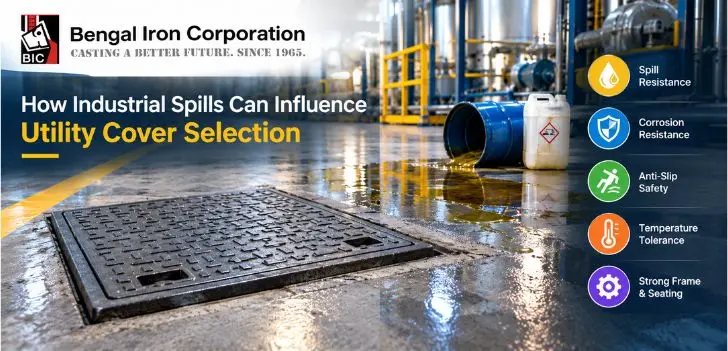
How Industrial Spills Can Influence Utility Cover Selection

When you walk through a busy industrial plant, you may notice some chemicals or liquids scattered around the floor. Sometimes a small amount of oil near a utility opening, or a cleaning chemical splashed across a floor, may need proper attention with a durable utility cover. In these cases, repeated washing can keep the floor wet and unsafe for industrial operations.

Over time, these situations can affect the performance, safety, maintenance requirements, and service life of the industrial utility cover. That’s why utility cover selection should be more than load-bearing capacity. In industrial units where spills, moisture, and chemicals require frequent cleaning, utility covers must suit the plant conditions. For industrial units, the right cast iron manhole cover is not just something that closes an opening; it becomes a wider safety measure for industrial infrastructure.
Now let’s explore how industrial spills can influence utility cover selection.

How to Select Utility Cover As Per Industrial Spill

In this section, we will discuss how to select utility cover based on the industrial spill.

1. Identify the spill type before selecting the utility cover

Not every industrial spill creates the same problem. Industrial units should choose a utility cover based on the substances they may handle. Consider whether the area is exposed to oils and lubricants, acids, alkalis, solvents, food processing liquids, cleaning chemicals, and process fluids. This helps industrial plants choose the right utility cover for the spill type.

2. Corrosion resistance becomes more important in a chemical environment

One of the most important questions for a plant that operates around chemicals is, ‘Can the recessed manhole cover India withstand the environment in which it will be installed? Cast iron and ductile iron are highly useful for industrial access and utility covers because of their strength and durability.

However, industrial units need to evaluate the surrounding environmental conditions such as chemicals, humidity, temperature, spills, and other factors while selecting the utility cover for manufacturing plants.

3. A wet and oily surface can change the safety equation

Imagine an employee is walking across a factory floor where oil, liquids, or chemical substances are scattered everywhere. These conditions can change suddenly, creating major safety risks. A smooth metal surface can become much harder to walk on when contaminated with liquids. That’s why anti-slip performance matters when buying a utility cover.

4. Surface design should balance grip and cleanability

A highly textured industrial flooring may improve traction, but if the floor design traps excessive oil, dirt, and chemical residue, cleaning becomes more difficult. In industrial plants where hygiene and contamination control are vital, surface design matters.

Industrial units should consider whether the surface provides reliable traction during sudden spills. When choosing a utility cover, balancing grip and cleanability is vital.

5. Consider temperature along with chemical exposure

Some industrial processes involve high temperatures. If the utility cover is near hot equipment, steam systems, or other heat sources, temperature variations may become a key selection factor. Repeated temperature changes can affect the utility cover material and other installation conditions.

Discuss this with a top manhole cover manufacturer in India to safeguard your industrial unit and ensure a smooth, reliable approach.

6. Consider the frame and seating

A properly designed and installed utility cover frame helps the cover to sit securely and transfer load appropriately into the surrounding structure. A proper utility cover and frame work together as a structural system in an industrial unit.

Depending on the chemical exposure risk, industrial units need to evaluate frame design, cover seating, sealing requirements, drainage, and surface level.

Conclusion

Industrial spills are one of the most important considerations when choosing a reliable, quality maintenance hole cover. If your industrial units are looking for a premium utility hole cover as per spill type, Bengal India Corporation (BIC) can be your reliable choice.

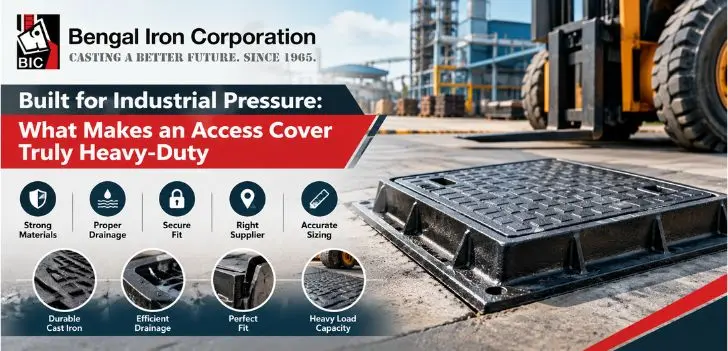
Built for Industrial Pressure: What Makes an Access Cover Truly Heavy-Duty

When an industrial access cover has to withstand significant weight, it should not be ignored. Proper selection of materials, designs, and construction is essential for proper functioning. Reviewing the cast iron chamber cover price is useful for comparing various models; however, cost should not be the only criterion for selecting a heavy-duty cover.

Factory settings tend to attract much traffic, stress, moisture, and usage. An efficient access cover should be able to withstand these factors without breaking, moving, or fitting out of place. By knowing what your load requirements are, along with materials, surface finish, and installation considerations, you will be able to make the right choice.

Various Ways to Make an Access Cover Truly Heavy Duty

Industrial covers should be able to support heavy weight, harsh weather, and frequent use. An industrial cover should be made from durable material and have a proper structure that can withstand difficult circumstances. It is important to choose an appropriate cover.

• Choose strong and durable materials

Choosing the right type of material is one of the essential considerations when deciding on an access cover. One of the materials that are widely used in industries is cast iron because of its strength and ability to withstand weight. Just note that the environment where it will be put determines its strength; thus, it should be much stronger than that used in a quiet path.

• Think about drainage needs

Access covers should be placed around the drainage and utility systems so that there is proper functionality with the drainage system. Inadequate flow of water will result in stagnant water, erosion, or even damage. Recessed drain covers provide an ideal solution for a clean look. Before installing it, ensure that the slope of the drain and the drainage pattern have been checked.

• Look for a secure and stable fit

The cover must fit securely inside its frame. Covers that don’t fit tightly usually move around because of the motion of the vehicle, thus making noise and leading to problems. You are required to make sure that the cover and the frame fit well. A good fit will prevent the cover from shifting during loading, while even the best cover can be ineffective when used on the wrong frame.

• Search for the right local supplier

Purchasing locally makes comparison, inquiries, and delivery easier. In searching for a manhole cover near you, don’t rely only on the closeness. Consider the variety of products, quality of the materials, and level of customer service of the seller. Make sure that technical specifications, such as load class and other details, are asked for in every purchase.

• Make sure the size is correct

Sizing is just as vital as the strength of access covers. Any mistakes in measuring the size of the access covers will result in problems while fitting the cover and pose a grave threat. It is highly necessary to take proper measurements, like the opening size, the frame size, and the depth of the access covers. Estimation can lead to mistakes in measurement. Comparisons should always be made between the new measurements and those of the manufacturer’s if replacing an existing cover.

Conclusion

The durability of an industrial-grade manhole cover should not be the only criterion when purchasing one; it should be chosen considering factors like the appropriate material, weight class, dimensions, finish, and suitable frame. It is recommended that the area where the manhole cover will be installed be assessed first before deciding on what product to purchase.

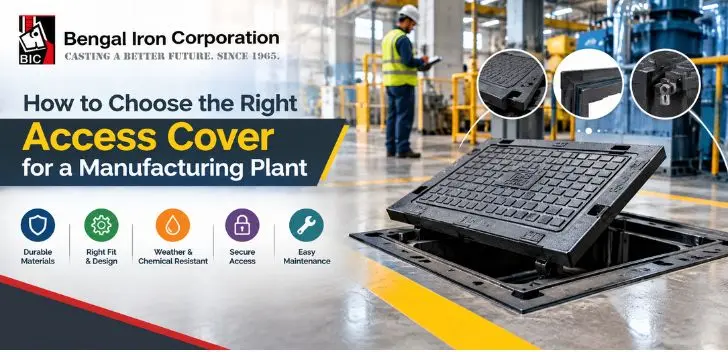
How to Choose the Right Access Cover for a Manufacturing Plant

A casting defect in an access cover may not be a big deal, but in a manufacturing plant, it can very quickly result in things like broken hinges and out-of-place frames. Precision is essential in a cast iron foundry in India, where metals are melted and cast into sand moulds, and that should definitely be a consideration when you make your decision. Cooling rate is something that foundry engineers have to consider to maintain strength, and the same should go for plant managers when evaluating weight-bearing capacity.

The process of choosing an ideal traffic cover starts with determining the type of traffic: use ductile iron for heavy-duty traffic because of its sturdiness, whereas other forms will suit light-duty traffic. Take into account the design of the cover, whether it is recessed or flush, bolted or hinged. Think about the sealing systems in case there are liquids and high temperatures. Get a cover which makes it easy to maintain.

Various Ways to Choose the Right Access Cover for a Manufacturing Plant

Your access hatch is the unsung hero of your plant floor, supporting tons of traffic daily while concealing important utilities. However, choosing the wrong hatch can turn it into a safety hazard.

• Understand the difference between grey iron and ductile iron.

Grey cast iron has high compressive strength but is inexpensive compared to ductile iron (otherwise known as nodular or spheroidal graphite iron) in regard to its tensile strength and shock resistance. Ductile iron is best suited for heavy traffic areas due to its high tensile strength and elongation ability. A DI manhole cover can endure an impact load which would break grey iron.

• Evaluate environmental conditions inside your plant.

Think about temperature variations, spills, humidity, and wash down procedures. Regular cast iron coverings function fine under normal weathering conditions, but if you have a plant that is using chemicals such as acids, alkalis, or salt water, choose galvanised or stainless steel coating on your covers. In a food or drug processing plant, there is a need for smooth, non-porous surfaces.

• Research local suppliers and check availability

Transporting cast iron covers, which are bulky items, over a considerable distance is an expensive venture with regard to logistics costs. Do not decide without searching for local suppliers first. All you need to do is make an Internet search using the key phrase “manhole cover near you.” This will help you find reliable local suppliers with shorter shipping times and other advantages.

• Choose the right frame and seating design.

The frame itself is just as important as the lid. Search for a deep groove cut into the material to guarantee a tight fit and no rattling when in use. The seat should be moulded to create a dust- and waterproof seal, crucial for plants that experience fine particles or any kind of runoff. Don’t settle for flat frames, which will collect dirt and become stuck.

• Consider locking and security mechanisms.

Unauthorised access to the underground utility can be risky. Covers that are fitted with tamperproof locking systems such as locking bolts, lock systems, or padlocks should be selected. Where security is an issue, it may be wise to consider covers that have some form of smart access control.

Conclusion

In picking the correct access cover, all one needs is to ensure harmony between the realities of the plant and the right quality of materials and design. One just needs to ensure that the material is durable, adaptable to the environment, and user-friendly. This should not be seen as a cost but as an investment.

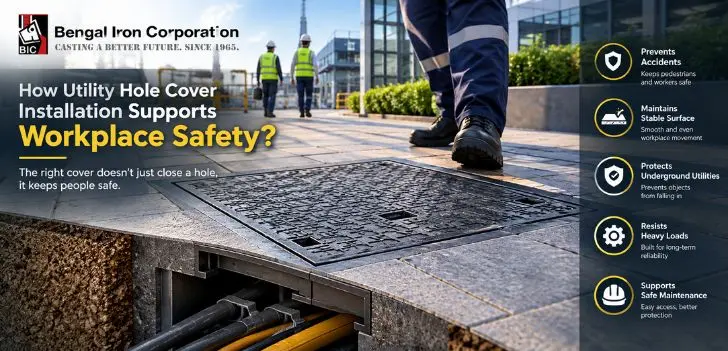
How Utility Hole Cover Installation Supports Workplace Safety?

Utility holes are among the most indispensable parts of modern-day infrastructure. From electrical cables to sewer lines, they provide access to almost every underground utility.

But if these access points are not covered properly, they may result in highly significant hazards to the workplace. They may even cost people’s lives. That is why it is essential to install the right type of recessed manhole cover in India.

It will not only create a highly stable workplace, but also help avoid unwanted dangerous incidents.

How Utility Manhole Covers Prevent Serious Injuries?

Are you aware of the most obvious risks associated with an improper cover on a manhole? Yes, it is none other than getting serious injuries by falling into it. A missing or improperly placed cover usually does not get noticed.

Thus, a person walking by, if they accidentally try to walk along, may fall inside the chamber. It will not only cause serious injuries, but may also cost a life as well.

Thus, installation of a cast iron manhole cover with proper dimensions is a fundamental activity. The cover may prevent unwanted accidents to both pedestrians and workers.

How Manhole Covers Help in Maintaining a Stable Surface?

Installation of the right type of manhole cover may ensure a stable surface in the workplace. It can integrate the access point into the surrounding surface effectively. Employees in industrial workplaces may easily shift equipment across.

A stable cover can prevent the hassles that are the outcomes of uneven edges, dilapidated frames, protruding sections, and rocks. It may also reduce the chances of workers having to compensate or change normal routes unnecessarily.

Does Utility Cover Protect People Below Too?

Fortunately, manhole covers extend safety in both directions. They can easily prevent objects from falling into a chamber underground. Such a great facility may protect workers below, if available.

It is especially important whenever maintenance personnel are working inside an underground project.

What Results in Shifting of the Cover?

At the time of installation of a manhole cover, it is essential to note that it is non-movable. Otherwise, it may result in another hazard. Some vital reasons that may lead to shifting of the utility cover are:

  • Loads of vehicles
  • Pedestrians walking by
  • Vibrations from heavy equipment
  • Improper installation of frame
  • Thermal expansion and contraction

Rather than installing a cover randomly, it is best to choose a reliable manufacturer. Specifying the accurate dimensions of the hole may help you get the right type of cover.

Your search for the right type of manhole cover near you that meets industrial standards may conclude at BIC India. With a decent choice, selecting the right option will be easy.

Consulting experts may also enable easy selection of the right manhole cover for your project. Proper design with correct load selection and installation by professionals are some additional perks to enjoy.

The right manhole cover will not only ensure the safety of workers, but also of ordinary people walking through.

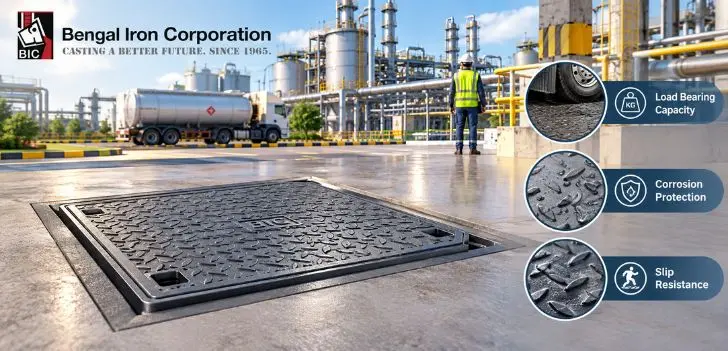
How to Select Utility Covers for Chemical and Process Plants?

High temperature, heavy machinery, and corrosive chemicals are indispensable in chemical plants. That is why strict safety requirements are essential in these infrastructures.

The installation of superb-quality recessed chamber covers in India is vital for safety. These covers look simple, but are great in terms of functionality.

They restrict access to underground utility chambers, drainage, and pipelines. They protect equipment and employees. Also, they create a safe working environment for workers and people all around.

Now, selecting the right type of utility cover demands several points to consider. From structural strength to regulatory needs, every factor influences making the right choice.

Engineers must consider the following factors while selecting manhole covers.

Does Load Bearing Capacity Make a Difference?

Load-bearing capacity is a critical factor while selecting a utility cover. The cover must support the load capacity during its service life.

Potential loads in chemical and process plants result lots of factors. Tankers, emergency vehicles, processing equipment, and maintenance personnel are among the most important. Both dynamic and static loading capacities must be considered.

Ordinary covers may tolerate nominal static weights but may not perform adequately. That is why impact loading, axle configuration, and greatest wheel load are important. These factors make the cover a complete structural system.

Does Protection to Corrosion Contribute a Great Factor?

Usually, a base material offers reasonable resistance to corrosion. But, for high safety, extra coating may be a great advantage. Galvanizing, powder coating, chemical resistance, and protective coatings may be additionally beneficial.

With the right coating, the cover may become highly suitable for outdoor weather. Also, it can easily withstand prolonged contact with the chemical. Covers with appropriate coatings may prevent high repair costs and early replacement.

Does Slip Resistance Make an Influence?

Generally, chemical and process plants comprise of highly strict safety regulations. Still, chemical spills and wet surfaces may occur at any time. A smooth metal cover may become slippery due to oil, cleaning solutions, and chemicals.

The cover selected from a cast iron factory must incorporate certain factors. A few of them include raised patterns, surfaces with high texture, anti-slip coating, special designs, and small holes.

The right type of surface can provide resistance to slipping, drainage, and cleanability. Aggressive textured surfaces are prone to trapping contaminants.

Thus, before making the final selection, anti-slip performance must be evaluated in detail.

As a Final Word!

Also, relevant plant engineering standards plus regulations for temperature need detailed research. This may create a highly safe working environment in both chemical and process plants.
Your search for the most compatible manhole cover near you may conclude at BIC India. Among a decent collection matching industrial standards, it is possible to find the most suitable utility cover.

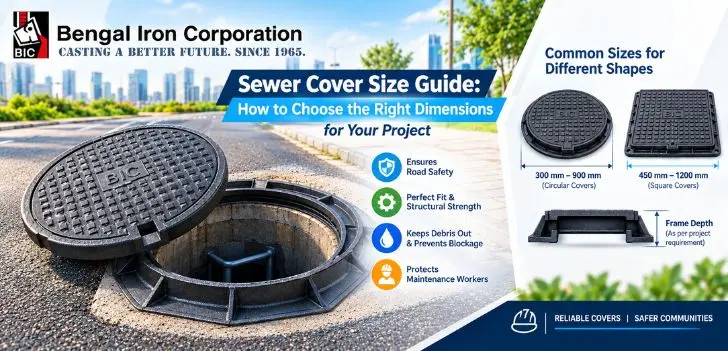
Sewer Cover Size Guide: How to Choose the Right Dimensions for Your Project

In the evolving civil engineering projects, selection of an appropriate sewer cover cannot be taken for granted. As the volume of road traffic is increasing fast, it is becoming crucial to consider the durability and performance of the cover.

For a safe and efficient drainage system, choosing the right size for a recessed chamber cover is very important. It not only ensures proper fitting, but also long-lasting performance.

Moreover, selection of the most appropriate dimension helps prevent accidents. It is time to delve into some key considerations that may aid in selecting the most appropriate size of a sewer cover.

Before that, it will be good to know the role of sewer covers in maintaining safety on roads.

How Do Sewage Covers Assure Safety Standards?

Sewage covers are flat and special types of plates that cover the opening of a manhole. Being removable, they provide access to the underground system. These covers are exclusively designed to keep debris out and prevent unauthorized entry.

By covering hazardous holes on roads and pavements, they are helpful in preventing accidents. Exclusively manufactured sewage covers protect pedestrians and vehicles from falling into manholes.

Also, they prevent clogging of underground systems from unwanted debris. These covers provide high security to maintenance workers too. The cast iron cover price may vary in terms of size and materials used for manufacturing

Now, it is time to consider vital tips that may help in choosing the appropriate size of the iron cover for the forthcoming project.

Why Measure the Opening Size of a Manhole?

At the time of selecting the size of a sewer cover, it must be ensured that the dimensions correspond accurately to the opening and structural base. A precise fit is crucial not only in terms of safety, but also for maintaining the structural integrity of the road.

It also ensures the security of underground utilities. The first step in selecting the right size includes measuring the clear opening size of the sewage. It is the dimension of the opening of the manhole chamber.

At the time of confirming the clear opening size, the measurement must take place from the side walls. It can be started from one side, followed by extending to the opposite side.

In case the covers comprise square or rectangular holes, then both length and width measurements are a must. In case of circular holes, measuring the diameter will be enough.

Is Frame Depth Also Important?

Another vital consideration is the frame depth into which the cover will be placed. The cover needs to be placed at the correct height with adequate support. A properly placed manhole cover may permit effective use of bedding materials.

Most common circular covers are available in sizes that range between 300 mm and 900 mm in diameter. Square and rectangular covers usually follow standard dimensions between 450 mm and 1200 mm.

As a Final Verdict!

Considering the following points may help in selecting the most appropriate cover for sewage. Still, do you want the best guidance and more detailed information about getting the best manhole cover near you?

Do not think twice before getting in touch with Bengal Iron Corporation. It has high specialization in manufacturing superb-quality ductile iron sewage covers for a safe and clean future.

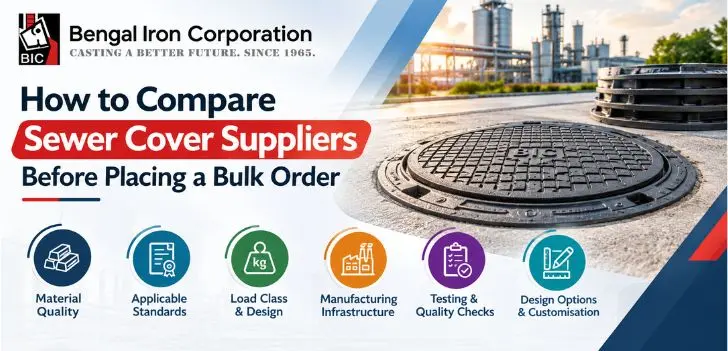
How to Compare Sewer Cover Suppliers Before Placing a Bulk Order

When you plan to order a bulk quantity of sewer or manhole covers for industrial use, comparing suppliers’ quality is essential. A bulk order is not just about choosing the manhole cover with the lowest quotation. It is about choosing a reliable sewer cover manufacturer that consistently uses top-notch materials, proper dimensions, proper finishing, and maintains the correct load class for the manhole cover.

Saving a few rupees should not come at the expense of manhole cover quality, which is essential for industrial safety. Whether you are contractors, infrastructure companies, municipalities, or developers, choosing the right recessed manhole cover manufacturer before placing a large order is essential for industrial safety.

In this blog, we discuss how to compare sewer cover suppliers before placing a large order.

Factors to Compare Sewer Cover Suppliers Before Ordering

In this section, we will discuss the factors you should consider when choosing a sewer cover manufacturer before placing an order.

1. Start with material quality

Most industrial units ask the sewer cover manufacturer about the budget-friendly process but forget the most important aspect: material quality. For major industrial infrastructure, cast iron and ductile iron are among the most essential material options for manhole covers. Ask the manufacturer about the material grade, metallurgical controls, and quality-checking process for the manhole cover.

• What material grade will be used?

• Is the material composition controlled?

• Is material testing carried out in-house?

A professional manhole cover manufacturer never feels uncomfortable answering these questions.

2. Checking of applicable standard

International quality and premium grade are two vital aspects to ask a manhole cover manufacturer about. Depending on the product and application, relevant standards may include Indian and international specifications. Thus, before ordering manhole covers in bulk, ask the manufacturer which standard applies to your project.

• Which standard is followed while manufacturing the product?

• What load class does the sewer cover meet?

• Can test reports or supporting documentation be provided?

This simple check can prevent expensive specification mismatch later.

3. Understand the load class before comparing quotations

Not every manhole cover is designed to survive under the same loading conditions. Ascertaining load class is particularly important for infrastructure projects where cast iron covers may need to be installed on roads, parking zones, industrial premises, or pedestrian zones.

Thus, try to ask the SG Iron Castings Manufacturer, ‘Which diameter cover works well with the correct opening, frame configuration, and particular load class?’ This type of question can help you make a meaningful comparison when buying top-notch quality cast iron manhole covers for different load scenarios.

4. Look beyond the product catalog

A polished product catalog can tell you what the manhole cover manufacturer sells. However, take a closer look at the manufacturing infrastructure before placing a large order. A reliable, trusted cast iron manhole cover manufacturer may have facilities for:

• Casting

• Pattern making

• Machining

• Load testing

• Dimensional inspection

• Material testing

• Final quality inspection

A trusted and famous manhole cover manufacturer offers an in-house machine shop, laboratory, load-testing machines, and shot-blasting equipment that allow process monitoring from raw material procurement to finished-product quality checking.

5. Ask about load testing and quality inspection

For manhole or sewer covers expected to withstand repeated loads, testing should be a vital part of the process. Thus, before placing an order, try to ask the prospective manhole cover manufacturer some essential questions-

• Is load testing performed?

• Is testing done in-house or externally?

• Are dimensional checks carried out

In-house load testing facilities ensure manhole covers meet essential load standards, building confidence for the procurement team.

6. Compare design, not just dimensions

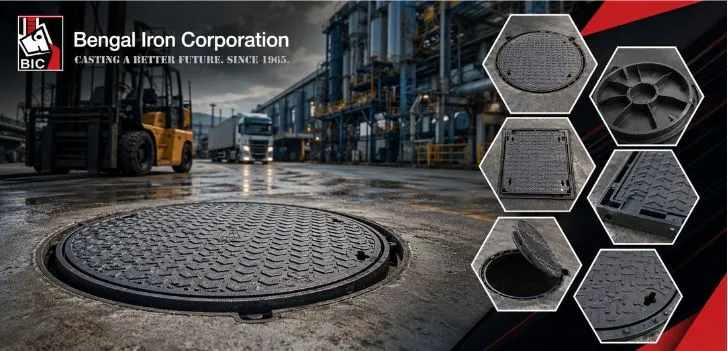
A sewer cover is more than a round or rectangular piece of metal. The cover and frame design can influence installation, stability, and handling capacity for a specific location. As per your industrial requirement, you can choose various designer manhole covers, such as-

• Round covers

• Square covers

• Rectangular covers

• Airtight covers

• Telecom covers

• Curb drain cover

If you search on Google for “top manhole cover near me,” try to consider the manhole design, material, and load class for long-term, seamless usability.

Conclusion

Choosing a trusted sewer cover supplier is essential for road projects, drainage networks, industrial development, and overall infrastructure growth. If you are looking for a trusted manufacturer of sewer covers, contact Bengal Iron Corporation (BIC). You can contact us through our website to place your order.

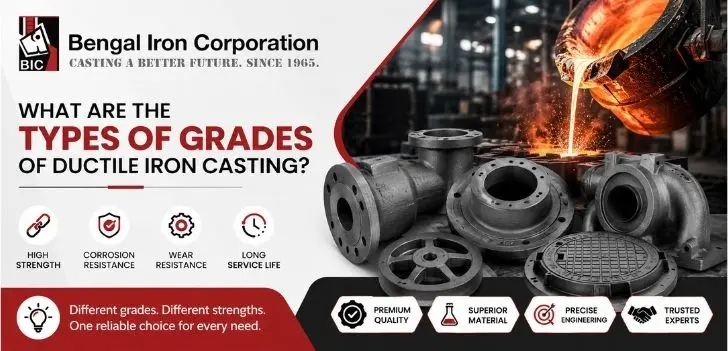
What are the Types of Grades of Ductile Iron Casting?

Ductile iron, as clear from the name, is a highly versatile type of metal that is utilized in a wide range of industries. Versatility can be inferred by the unique properties that make it both flexible and durable.

Advantages of purchasing from a reliable and trustworthy ductile iron castings manufacturer may be unlimited. Along with ensuring low melting point, high tensile strength, and advanced machinability are some additional features to come across.

Unlike cast iron, ductile iron is considered to be less brittle. Also, it requires low maintenance. Having exposure to various grades may allow in categorizing castings based on tensile strength, elongation, and yielding ability.

These three indicate the overall mechanical performance of the casting that may be appropriate as per the application.

What Sets Ductile Iron Apart from Ordinary Iron?

At the time of casting ductile iron, magnesium is added to molten iron in the proper ratio for solidification. This specific process alters the overall formation of graphite to spheroids.

The unique microstructure of the ductile iron imparts special properties like strength, flexibility, and durability. That is why it has revolutionized several industries. Exclusive spherical nodules in this nodular iron upgrade its pliability and resistance to cracking under high stress.

Also, the appreciable elongation rate of ductile iron is another appreciable quality. After getting an idea, it will be better to know about variable casting grades before approaching a trustworthy SG iron castings manufacturer.

What are the Different Grades of Cast Iron?

It is possible to obtain the desired ductile iron grade by controlling the overall structure of the matrix that forms around the graphite nodules. Usually, it falls under the standard ASTM A536 specification.

Grades have been further classified in a series of three, where each one relates to a different property. The first number represents tensile strength, the second one yield strength, and the last one elongation rate.

Some of the most popular grades of ductile iron include the following:

Grade 65-45-12

The series 65-45-12 represents a highly ductile and easy -to-machine grade. Though the yield and tensile strengths seem to be a bit low, it comprises a high elongation rate.

Its unique graphite structure makes it extremely suitable for variable applications like pumps, brakes, and compressors.

Grade 80-55-06

Another series, 80-55-06, represents moderate ductility with higher tensile strength. This is a special type of ductile iron that is used in pumps, brakes, gearboxes, and wind-resistant components.

Also, such an exclusive grade exhibits appreciable resistance to corrosion. The property may get further enhanced by incorporating superior elements like nickel, copper, and chromium.

Grade 100-70-03

Series 100-70-03 represents an extremely durable and strong grade of ductile iron. Though it indicates a low elongation rate, this type of iron may remain stable in high temperatures.

Usually, it is commonly used in transmissions and in machine components that require high strength.

As a Final Word!

By getting familiar with the different types of grades of ductile iron, choosing the most appropriate option for the upcoming project will be no more difficult. The most appropriate grade will permit maximum efficiency and longevity, but with cost effectiveness.

Your search for a reliable manufacturer of ductile iron manhole cover near you may conclude with BIC India. Getting in contact with a team of experienced professionals will allow you to come across the most suitable item matching the project needs.

Industrial Access Covers: How Design Impacts Strength and Service Life

When an industrial unit installs an industrial access cover, you may think of it as a simple cover over an underground opening. However, in reality, the scenario is completely different. A heavy-duty industrial access cover is designed specifically to handle the loads of heavy vehicles, harsh weather, constant vibration, and the stress of daily industrial operations.

Whether it is an industrial plant, warehouse, manufacturing unit, or road, drainage cover design plays a vital role in determining the strength and service life of the industrial access cover. A well-designed recessed manhole cover serves more than just an opening. It protects underground utilities, supports surface traffic, enables safe maintenance, and helps reduce premature replacement of drainage covers.

Thus, industrial units need to choose a durable drainage cover based on material, geometric shape, frame design, surface finish, and robust installation.

Let’s explore this blog to ascertain how the design of an industrial access cover impacts strength and service life.

How Design of Industrial Access Covers Impacts Strength and Service Life

In this section, we will discuss how the design of industrial access covers impacts strength and service life.

1. Material selection is the foundation for performance

Both cast iron and ductile iron are widely used for industrial drainage covers because of their strength and durability. Thus, industrial units must choose the drainage cover material according to the expected loading conditions, environment, dimensions, and intended application.

2. Load distribution influences the service life

A durable industrial drainage cover, supported by the top manhole cover manufacturer in India, must have specific load-bearing capacity. When a truck, construction vehicle, or heavy equipment passes over it, external forces act on the drainage cover, frame, and surrounding pavement.

In such a case, poor load distribution can create localized stress that can cause cracking, deformation, and premature wear of the drainage manhole cover. Thus, it is vital to consider the manhole cover’s reliable load-bearing capacity for long-term use.

3. Drainage cover thickness and structural geometry matter

The structural geometry of a drainage cover matters when considering an industrial access cover. Thickness, reinforcement, underside configuration, and ribs can influence how a cover responds to pressure.

A thoughtfully engineered drainage cover design can achieve an effective balance among structural strength, weight, load-bearing performance, material utilization, and long-term durability. For an industrial unit, this proportion is essential because the drainage cover must be periodically removed for maintenance.

4. The drainage cover frame is important

The frame of a durable drainage cover is an important aspect because an industrial access cover transfers load through the cover and into the supporting frame and surrounding structure. If the drainage cover frame does not provide adequate support, or is poorly installed, a durable drainage cover cannot perform well.

A properly designed drainage cover and frame system provides better load transfer, improves stability, reduces movement, and enhances alignment.

5. Integrated surface design

An integrated surface design of an industrial access cover can help provide traction and reduce the possibility of slipping in areas exposed to rain, water, oils, and dust. The industrial access cover should be properly aligned with the surrounding pavement and floor.

A minor difference in surface design may appear insignificant during installation but can cause major problems in daily life. When you consider the cast-iron chamber cover price, the integrated surface design also has a great impact. Thus, do not overlook integrated surface design features for the industrial access cover.

6. Shape and seating affect stability

Industrial access covers are available in different shapes and configurations depending on the application. Industrial units can choose circular, square, or rectangular configurations based on installation requirements.

A seating arrangement is also equally important. A drainage cover that sits securely within its frame can provide better sturdiness under huge external stress. Proper alignment also helps reduce unwanted movement and surface-level hazards. In busy industrial areas, the proper shape and seating can greatly affect the stability of the industrial access cover.

Conclusion

The proper design of an industrial access cover can greatly affect its strength and service life. If your industrial unit requires a reliable industrial access cover, contacting a trusted drainage cover manufacturer can help. At BIC (Bengal Iron Corporation), you can experience a wide range of customized, durable, and high-quality drainage covers that can definitely fulfill your industrial requirements.

Enquire Now

Get In Touch
×
Best Cast Iron Supplier Top Ductile Iron Manufacturer