
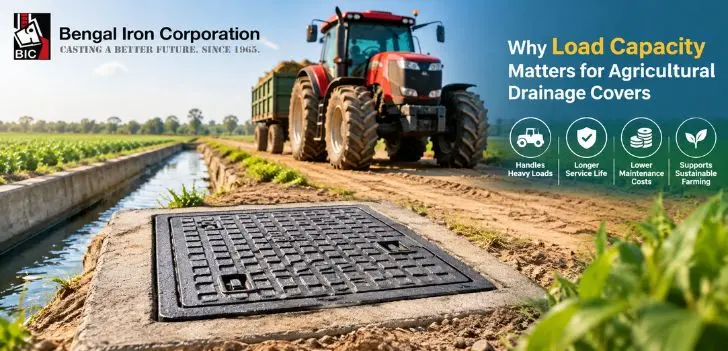
Why Load Capacity Matters for Agricultural Drainage Covers

A successful agricultural environment depends on more than fertile soil, healthy crop rotation, and adequate rainfall. Beneath the agricultural land, durable, reliable drainage channels, irrigation pipelines, inspection chambers, and underground utilities help farms operate efficiently. These systems need to remain accessible for regular inspection and maintenance, and agricultural drainage covers play an important role.

When a tractor crosses a farm access road after heavy rain, it requires a robust surface. Beneath its wheels, a durable drainage chamber cover can withstand heavy loads. Without durability, the drainage cover may crack, shift, or be damaged, disrupting regular farm operations. That’s why load capacity is vital when choosing agricultural casting. The right drainage covers can withstand loads and support smooth agricultural operations.

Now let’s explore this blog to ascertain why load capacity matters for agricultural drainage covers.

Why Load Capacity Is Essential for Agricultural Drainage Covers

If the agricultural industry wants to know why load capacity is essential when choosing agricultural drainage covers, this section can help.

1. Agricultural sites face more than one type of load

A drainage cover installed beside an irrigation channel may experience very different conditions from one positioned on a road connecting two sections of a farm. Farm vehicles such as tractors and agricultural machinery can create substantial wheel loads. That’s why manhole covers located on these routes need an appropriate load class. Trucks that carry fertilizer, seeds, harvested crops, and other supplies may expose covers to repeated heavy wheel loads.

2. Understanding manhole cover load class

Understanding load classifications helps manhole cover buyers compare manhole cover quality against the demands of their intended installation. For buyers considering ductile iron covers from trusted cast iron factories, load classification is a vital factor. The appropriate load class helps determine the right manhole cover based on location, anticipated traffic, and project specifications.

3. Why the right load capacity reduces long-term maintenance costs

An unsuitable drainage cover can create huge maintenance expenses that sometimes exceed the original purchase price. That’s why agricultural land maintenance teams need to arrange an inspection, restrict access to the affected area, remove the damaged cover, and install a replacement maintenance cover. If the agricultural drainage chamber cover serves an important irrigation or utility route, it can interrupt normal farm operations.

4. Cast iron or ductile iron

Material selection is also vital for agricultural drainage covers. Grey cast iron and ductile iron manhole covers have different infrastructure requirements. The best option depends mainly on project specifications, expected loads, product design, budget, and the installation environment.

A procurement team searching for manhole covers for a large irrigation development may need to balance structural performance with transportation costs. A project with heavy vehicle traffic may place greater emphasis on the specified load class and provide reliable performance.

5. Frame and installation matter for maintenance hole covers

A common purchasing mistake in the agricultural sector is focusing on the cover itself while ignoring the frame quality, bearing surface, installation quality, and supporting structure. Even a top-quality manhole cover from a reliable manhole cover manufacturer India that meets its specified load class may cause major problems if it sits unevenly without a proper supporting frame. In such situations, repeated vehicle movement can make the problem even worse.

Conclusion

When planning agricultural drainage infrastructure, buyers need to think beyond the durability and quality of manhole covers. With appropriate technical specifications and proper installation, agricultural farms can get top-quality manhole covers. At BIC (Bengal Iron Corporation), you can find a range of grey iron and ductile iron manhole covers for agricultural land. Visit our online portal to explore our wide range of cast iron manhole covers.
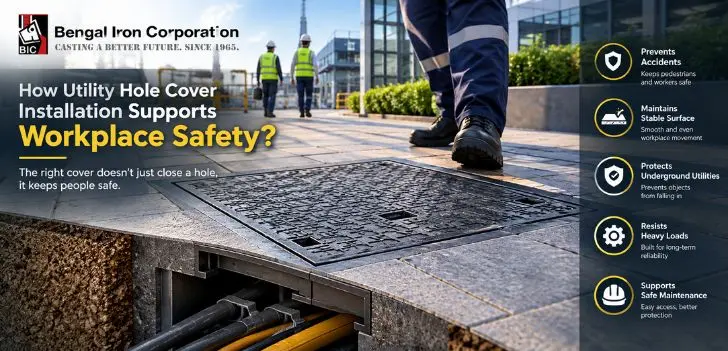
How Utility Hole Cover Installation Supports Workplace Safety?

Utility holes are among the most indispensable parts of modern-day infrastructure. From electrical cables to sewer lines, they provide access to almost every underground utility.

But if these access points are not covered properly, they may result in highly significant hazards to the workplace. They may even cost people’s lives. That is why it is essential to install the right type of recessed manhole cover in India.

It will not only create a highly stable workplace, but also help avoid unwanted dangerous incidents.

How Utility Manhole Covers Prevent Serious Injuries?

Are you aware of the most obvious risks associated with an improper cover on a manhole? Yes, it is none other than getting serious injuries by falling into it. A missing or improperly placed cover usually does not get noticed.

Thus, a person walking by, if they accidentally try to walk along, may fall inside the chamber. It will not only cause serious injuries, but may also cost a life as well.

Thus, installation of a cast iron manhole cover with proper dimensions is a fundamental activity. The cover may prevent unwanted accidents to both pedestrians and workers.

How Manhole Covers Help in Maintaining a Stable Surface?

Installation of the right type of manhole cover may ensure a stable surface in the workplace. It can integrate the access point into the surrounding surface effectively. Employees in industrial workplaces may easily shift equipment across.

A stable cover can prevent the hassles that are the outcomes of uneven edges, dilapidated frames, protruding sections, and rocks. It may also reduce the chances of workers having to compensate or change normal routes unnecessarily.

Does Utility Cover Protect People Below Too?

Fortunately, manhole covers extend safety in both directions. They can easily prevent objects from falling into a chamber underground. Such a great facility may protect workers below, if available.

It is especially important whenever maintenance personnel are working inside an underground project.

What Results in Shifting of the Cover?

At the time of installation of a manhole cover, it is essential to note that it is non-movable. Otherwise, it may result in another hazard. Some vital reasons that may lead to shifting of the utility cover are:

  • Loads of vehicles
  • Pedestrians walking by
  • Vibrations from heavy equipment
  • Improper installation of frame
  • Thermal expansion and contraction

Rather than installing a cover randomly, it is best to choose a reliable manufacturer. Specifying the accurate dimensions of the hole may help you get the right type of cover.

Your search for the right type of manhole cover near you that meets industrial standards may conclude at BIC India. With a decent choice, selecting the right option will be easy.

Consulting experts may also enable easy selection of the right manhole cover for your project. Proper design with correct load selection and installation by professionals are some additional perks to enjoy.

The right manhole cover will not only ensure the safety of workers, but also of ordinary people walking through.

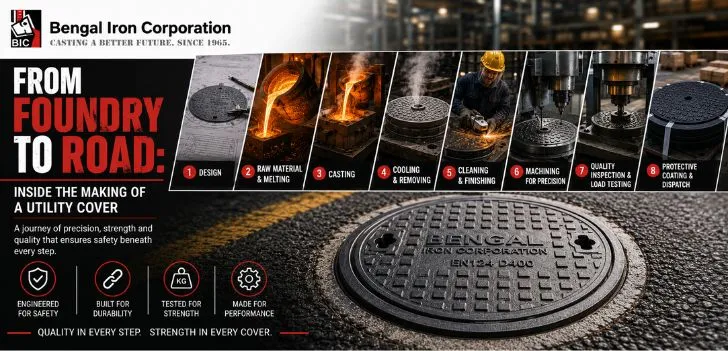
From Foundry to Road: Inside the Making of a Utility Cover

Have you ever walked over a utility cover without giving it a second thought? Most of us have. Yet beneath every durable cover lies a remarkable manufacturing journey that combines engineering, precision, and quality control. Utility covers play a critical role in protecting underground networks, including drainage systems, water pipelines, electrical cables, and communication lines. Hence, they must withstand heavy traffic, harsh weather, and years of continuous use.

Many buyers focus only on the cast iron chamber cover price, but the manufacturing process is what truly determines the product’s quality and lifespan. That is why every stage of the production matters. From selecting raw materials to conducting final quality checks, manufacturers follow a carefully planned process to ensure every cover performs safely on the road. In this blog, we will highlight the major steps included in manufacturing a utility cover.

How a Utility Cover Transforms from Raw Material to Road-Ready Infrastructure

In the segment below, we will explore how a recessed manhole cover in India moves through every stage of manufacturing, from raw materials to a reliable road-ready structure.

Designing the Utility Cover

The first notable step in making a utility cover is deciding its design. First, engineers determine the size, load-bearing capacity, locking mechanism, surface pattern, and application. A cover designed for a residential footpath differs greatly from one meant for busy highways or industrial zones. Every design follows relevant industry standards to ensure safety and durability.

Selecting High-Quality Raw Materials

The next step in making a utility cover is to select high-quality raw materials. The strength of a utility cover begins with its raw materials. Manufacturers always choose premium-grade iron and other required alloys to achieve the desired mechanical properties. Selecting high-quality materials improves resistance to corrosion, impact, and long-term wear, making the finished product dependable under demanding conditions.

Melting and Casting

Once the raw materials are ready, the workers melt them in high-temperature furnaces. The molten metal is then carefully positioned into prepared moulds that match the required design. This casting stage demands exceptional precision because even small defects can affect the strength and performance of the final product.

Cooling and Removing the Casting

After pouring, the molten metal is allowed to cool naturally until it solidifies. The newly formed casting is then removed from the mould. Skilled workers inspect the casting visually before moving it to the next production stage.

Cleaning and Finishing

Freshly cast utility covers often have excess metal, rough edges, and surface impurities. These imperfections are removed through grinding, shot blasting, and surface finishing. This step improves both appearance and structural integrity while preparing the cover for further inspection.

Machining for Precision

Many of us are unaware that certain utility covers require machining to achieve accurate dimensions and a perfect fit. Precision machining ensures that the cover sits securely within its frame, reducing movement, noise, and unnecessary wear after installation.

Quality Inspection and Load Testing

This is one of the most critical stages of the manufacturing process. Each utility cover undergoes strict quality inspections, dimensional checks, and load tests to verify its strength and reliability. Only products that meet established quality standards move forward for dispatch.

Protective Coating and Dispatch

Finally, manufacturers apply protective coatings to enhance corrosion resistance and extend service life. After packaging and final verification, the utility covers are shipped to infrastructure projects, municipalities, construction companies, and industrial sites, ready to serve for decades.

The Conclusion

So, every utility cover tells a story of engineering expertise, skilled craftsmanship, and rigorous quality control. From the first design sketch to the final installation on roads, each manufacturing stage contributes to creating a product that protects vital underground infrastructure while ensuring public safety.

If you are looking for premium-quality utility covers manufactured with precision, durability, and uncompromising quality standards, Bengal Iron Corporation can be your trusted partner. With years of manufacturing excellence and a commitment to superior engineering, Bengal Iron Corporation delivers reliable utility cover solutions that stand the test of time. So search for the term ‘manhole cover near me’ and get in touch today, and invest in products built for performance, safety, and lasting value.

How Utility Access Lids Prevent Contamination

Access lids of utilities have been considered paramount in maintaining safety, hygiene, and efficiency in underground systems that include water and sewage provisions, electrical, and telecom networks. Such utility lids protect sensitive utility chambers against contaminants, debris, pests, and unauthorized materials. In case such systems are not well-protected, they are highly at risk of contamination, hence compromising the service reliability, public health, and the infrastructure life span. You can make the best utility lids with the best Cast iron factory.

Utility access lids are an indispensable component to ensure that all utility systems are clean, safe, and function effectively. They seal tightly to prevent water infiltration, block off any exposure to chemicals and other pollutants, and bar pests and wildlife from the utilities area. Such utility access lids support the integrity of the system and drastically reduce maintenance costs. Fully realizing the need for such small components makes their contribution very important in the protection of utilities and communities dependent upon them.

Utility Access Lids Serve to Prevent Contamination in Many Ways

Utility access lids can protect underground systems from dirt and contamination. By covering the access points, they prevent debris, water, chemicals, and pests from penetrating infrastructure that could be crucial to sustaining public health and essential services.

Provide a physical barrier against dirt and debris

Manhole covers near you effectively seal off underground systems from water, sewage, electrical, and telecom lines against external contaminants. This tight protection keeps dirt, sand, leaves, garbage, and other debris from reaching the utility chamber so as to ensure flawless operation and protection of the integrity of these important systems.

Block chemical and pollutant exposure

The problem of pollution seeping into underground systems becomes acute, especially in industrial and highly urban environments. Missing or inadequately sealed manhole covers allow all forms of chemicals, oils, fuels, and other hazardous materials to find easy passage into subterranean infrastructures.

The main purpose of high-quality lids is to provide a critical barrier protecting these utilities from contamination and preserving the integrity of the underground ecosystem. Well-constructed lids prevent the permeation of harmful pollutants and, therefore, play a key role in safeguarding public health and environmental quality.

Develop the order-control conditions

The structure of the utility lids is ingeniously designed to be airtight; it effectively closes off the utility system from the outside. That keeps the air free from contamination and foul odors, protecting air quality both above and underground. This barrier will essentially contribute to a hygienic environment for safety and cleanliness both at ground level and in the layers beneath. Let Ductile Iron Castings manufacture your utility lids to control the order perfectly.

Preserve the system pressure and flow integrity

Pressure and flow should be optimal in a water and wastewater system to avoid any kind of cross-contamination. A well-fitted and tightly secured lid is, therefore, important in the creation of such a controlled environment. The barrier will protect not only internal operations but also external ones from intruding into the sensitive processes of maintaining water purity and system integrity.

Waterproofing helps to protect against water infiltration

Good lids fix this problem by using gaskets or tight edges that keep out rain, stormwater, and runoff. That way, the water inside stays clean, and you don’t have to worry about flooding or anything getting watered down.

Conclusion

Utility access lids block underground systems from getting contaminated with debris, water, chemicals, and pests. It keeps everything tidy, safe, and just works. Correct utility access lid design and maintenance also minimize the risk of contamination, while prolonging infrastructure life spans, hence the importance of such a small yet substantial component to maintain our safe and functional communities.

How to Identify What Type of Utility an Access Point Protects

Access points are the entry points to subsurface utility infrastructure like manholes, valve boxes, junction cabinets, and vaults, for inspection and repair. They supply critical services such as electricity, water, gas, sewage, and telecommunications. Labeling each utility that serves an access point is paramount for safety, particularly during construction, since mislabeling the hit line has service disruption implications and potential hazard. With the assistance of an appropriate cast iron chamber cover near me are able to address some critical issues.

Utility types also come with some labeling necessity, color coding, shape, and location to ensure they can be easily recognized. For instance, electricity may be colored red, and water colored blue. Special materials, shapes, and symbols also serve as clues. Their recognition facilitates it to be simple for employees, planners, and the public to identify the utility access points.

Tips for Identifying the Types of Utility an Access Point Protects

We need to identify the character of utility behind an access point in order to allow safety, avoid service interruption, and assist proper maintenance or construction activity. Certain key points to notice are presented below to assist you to conclude what utility an access point is.

Labels and markings

Access points are usually also well-written or precisely printed with titles of use and application. Not only are such titles convenient information, but also to a certain degree, help in the planning and planning out of the room so that users can recognize with ease the usage of every access point.

Use of utility locating tools

For accurate and trustworthy identification, experts normally turn to sophisticated equipment like electronic utility locators and ground-penetrating radar (GPR). The sophisticated equipment is used to sweep through subsurface infrastructure, such as pipes and cables, to acquire in-depth knowledge about the underground world prior to excavation or digging.

With the purpose of using these technologies, people are able to locate exactly where the utilities are and hence minimize the danger of damage and increase safety when constructing. By choosing the best manhole cover near me, you are also able to minimize the danger of injury.

Material of cover

Various utility companies utilize a wide array of materials, well-suited for longevity and strong safety considerations. Each material is selected with particular requirements and specifications in mind to not only offer long performance record but also protect in a safe and secure manner the infrastructure and individuals it accommodates. Each element is part of a strong and secure system through the prudent selection to maximize every aspect of vital services.

Use records and maps

City planners and construction crews can turn to official utility maps or “as-built” drawings in an effort to precisely confirm what’s under the ground. These detailed reports take exacting care to determine the location of the different utilities, water, gas, electricity, and telecommunications, and their respective types and points of entry. Through the creation of an all-encompassing visual documentation, they are critical to effective urban planning and secure digging, reducing the potential for destruction of installed infrastructure.

Conclusion

It is an important skill, knowing and knowing where utility access points are. Visual inspection, location context, typical indications, and professional tools or maps enable you to ascertain what kind of utility lies beneath an access point in a safe and proper manner—safeguarding humans and utilities from potential damage.

How Access Covers Integrate with Underground Utilities

In fact, the development of high-strength and quality infrastructure buildings is even more critical in the contemporary dynamic cities and agglomerations, which are marked by a continuously growing population. Utility hole covers or access covers play a crucial role in maintaining the safety and integrity of the public and private spaces. You need to procure the best access cover, and for that, SG Iron Castings Manufacturer is the place to go to.

Access covers, also known as manhole covers or utility covers, are critical elements in the efficient functioning and upkeep of underground utilities. The durable covers are specifically engineered to offer safe and secure, convenient access beneath the systems while safeguarding the systems against damage and abuse above. Their role in interacting with underground utilities cannot be overemphasized.

Various Techniques Access Covers Integrated with Underground Utilities

Structural Integration

Access covers are tailor-made with a strong frame cast in concrete or asphalt and a removable cover. The frame ensures a close fit for the cover, which is locked until use. The covers are typically constructed from heavy-duty material, e.g., ductile iron, composite, concrete, or steel, based on the load requirement and surrounding conditions.

Each cover is designed to provide rigorous ratings of loads—light-duty for walkways and heavy-duty for highways—so that they can be safe to use and last long. Through the services of Recessed Manhole Cover India, all can be made safe and avoid any accidents.

Security and safety integration

Some of them are provided with safety features, including locks or bolt-down units, to ensure effective protection against unauthorized access. Where there are obligatory utilities, including sewers and gas lines, vented covers are a requirement; they ensure safe venting of gases to provide a safe environment. To avoid slipping accidents—especially in wet or moist environments—some covers are textured or have non-slip coating, thus ensuring everyone who comes in contact with them is secure.

Environmental and urban planning considerations

To ensure that utility systems are not impacted by rainwater and contaminants, contemporary system designs feature improved sensors that are appropriate for real-time monitoring. The sensors are able to identify floods and alert against trespassing, and it is feasible to add an active mechanism to ensure system integrity. In the urban environment, access covers are not only beneficial but also prove to be visually pleasing, in the majority of cases, designed to become part of the cityscape or to serve as a reminder of regional heritage, and therefore feature an artistic element and ensure safety. With assistance from the best Manhole Cover Manufacturer in India, you do not have to be concerned with sustainability.

Location-based integration

They are typically lettered in big, clear letters, such as “SEWER,” “WATER,” or “ELECTRIC,” which identify the type of facility below. They are typically square or circular and are made in various sizes to meet the specific access needs of each facility. They are installed with great care, sloped to the adjacent surfaces, to enable smooth incorporation that reduces the risk of tripping by pedestrians and protects against possible damage to vehicles.

Access covers are a vital connection between the street surface and the intricate city-wide network of underground utilities that lie beneath. Through safe, long-lasting, and accessible access points, they are indispensable in the functioning of utilities, yet provide public safety and city functionality.

As urban spaces continually develop, access cover technology is also developing, incorporating smart systems and high-performance materials that increase performance, durability, and resilience. These advances ensure fault-free access and considerably enhance the overall resilience of the infrastructure itself, effectively overcoming the greater demands and environmental pressures we are experiencing.

Enquire Now

Get In Touch
×
Best Cast Iron Supplier Top Ductile Iron Manufacturer