
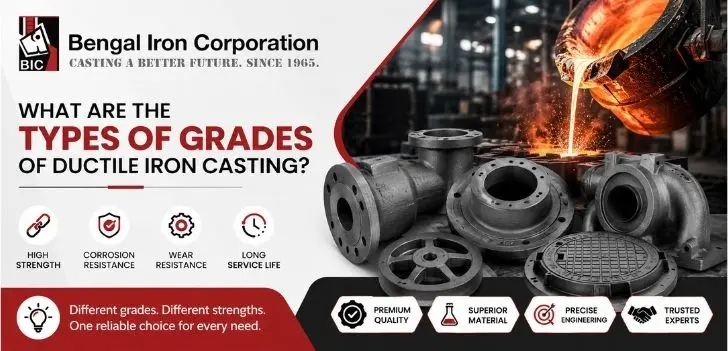
What are the Types of Grades of Ductile Iron Casting?

Ductile iron, as clear from the name, is a highly versatile type of metal that is utilized in a wide range of industries. Versatility can be inferred by the unique properties that make it both flexible and durable.

Advantages of purchasing from a reliable and trustworthy ductile iron castings manufacturer may be unlimited. Along with ensuring low melting point, high tensile strength, and advanced machinability are some additional features to come across.

Unlike cast iron, ductile iron is considered to be less brittle. Also, it requires low maintenance. Having exposure to various grades may allow in categorizing castings based on tensile strength, elongation, and yielding ability.

These three indicate the overall mechanical performance of the casting that may be appropriate as per the application.

What Sets Ductile Iron Apart from Ordinary Iron?

At the time of casting ductile iron, magnesium is added to molten iron in the proper ratio for solidification. This specific process alters the overall formation of graphite to spheroids.

The unique microstructure of the ductile iron imparts special properties like strength, flexibility, and durability. That is why it has revolutionized several industries. Exclusive spherical nodules in this nodular iron upgrade its pliability and resistance to cracking under high stress.

Also, the appreciable elongation rate of ductile iron is another appreciable quality. After getting an idea, it will be better to know about variable casting grades before approaching a trustworthy SG iron castings manufacturer.

What are the Different Grades of Cast Iron?

It is possible to obtain the desired ductile iron grade by controlling the overall structure of the matrix that forms around the graphite nodules. Usually, it falls under the standard ASTM A536 specification.

Grades have been further classified in a series of three, where each one relates to a different property. The first number represents tensile strength, the second one yield strength, and the last one elongation rate.

Some of the most popular grades of ductile iron include the following:

Grade 65-45-12

The series 65-45-12 represents a highly ductile and easy -to-machine grade. Though the yield and tensile strengths seem to be a bit low, it comprises a high elongation rate.

Its unique graphite structure makes it extremely suitable for variable applications like pumps, brakes, and compressors.

Grade 80-55-06

Another series, 80-55-06, represents moderate ductility with higher tensile strength. This is a special type of ductile iron that is used in pumps, brakes, gearboxes, and wind-resistant components.

Also, such an exclusive grade exhibits appreciable resistance to corrosion. The property may get further enhanced by incorporating superior elements like nickel, copper, and chromium.

Grade 100-70-03

Series 100-70-03 represents an extremely durable and strong grade of ductile iron. Though it indicates a low elongation rate, this type of iron may remain stable in high temperatures.

Usually, it is commonly used in transmissions and in machine components that require high strength.

As a Final Word!

By getting familiar with the different types of grades of ductile iron, choosing the most appropriate option for the upcoming project will be no more difficult. The most appropriate grade will permit maximum efficiency and longevity, but with cost effectiveness.

Your search for a reliable manufacturer of ductile iron manhole cover near you may conclude with BIC India. Getting in contact with a team of experienced professionals will allow you to come across the most suitable item matching the project needs.
Understanding the Importance of Mold Design in the Casting Process

Mold design plays a crucial role when casting. This is because there are parts that require precise measurements. There is an SG iron castings manufacturer that knows well that the mold determines not only how it will hold the metal but also how the cooling process will take place to determine the final product. A small mistake in the design may cause serious complications like shrinking, warping, and poor finishing.

Mold designing is essential since it influences all aspects of manufacturing. Flow paths, gating, vents, and cooling time play an important role in determining the quality of the finished product, but this does not necessarily mean it is always apparent. In casting, proper mold design ensures molten metal is formed into parts with a high degree of reliability.

Understanding the Importance of Mold Design in the Casting Process

Molds play a very important role in the casting process since they dictate how the metal cools down. A properly designed mold will prevent flaws, improve surface finishes, and provide dimensional accuracy at minimal cost.

Mold design sets the tone before anything else happens

The cast starts with the mold, the most important consideration for your project. You need a good mold design. Without it, you will always have problems, resulting in an inferior final product. Taking the time to create a quality mold saves trouble later on.

Flow of metal is everything

The melted metal will run fast through the mold and cool down in shape formation. This process is not always easy since it may have defects such as voids and improper fillings caused by a defective mold design. Proper redesign of the mold can eliminate those defects that could otherwise be viewed as defects in the metal itself. This is particularly necessary in the case of robust parts, such as the recessed chamber cover. If the filling isn’t even, it can create weak spots that may cause the part to fail under stress.

Dimensional accuracy keeps everything usable

When a casting is produced with even slight inaccuracies, it can cause significant problems during assembly later. In many workshops, you will often hear experienced craftsmen say, it fits after machining. This means the molding process lacked sufficient precision and control, potentially requiring extensive adjustments to ensure everything fits properly in subsequent production steps.

Shrinkage compensation is non-negotiable

During the cooling process of metal, contraction occurs. If the engineers fail to consider the factor during planning, then problems could arise unexpectedly. Good designs take this into consideration when the metal starts to contract, thus ensuring the proper fitting of the metal parts. This is particularly applicable in large municipal parts like the manhole cover manufacturer in India. The few millimeters difference will have an impact on the effectiveness and safety of the part.

Consistency is where real value shows up

Producing a successful casting on the first try can be easy, but the real challenge is consistently producing a hundred identical castings. This is where good mold design is important. It is important to make sure that the casting process can be replicated with similar results, without having to keep making modifications.

Conclusion

Mold design is an important consideration for the casting process. Good mold design will make everything easier, faster, defect-free, and with parts meeting all the specifications. Bad mold design, on the other hand, will lead to problems related to cooling, shrinking, and fitting, despite the material and processes being good. The best casting starts from the right mold, not from the molten metal.

Enquire Now

Get In Touch
×
Best Cast Iron Supplier Top Ductile Iron Manufacturer