
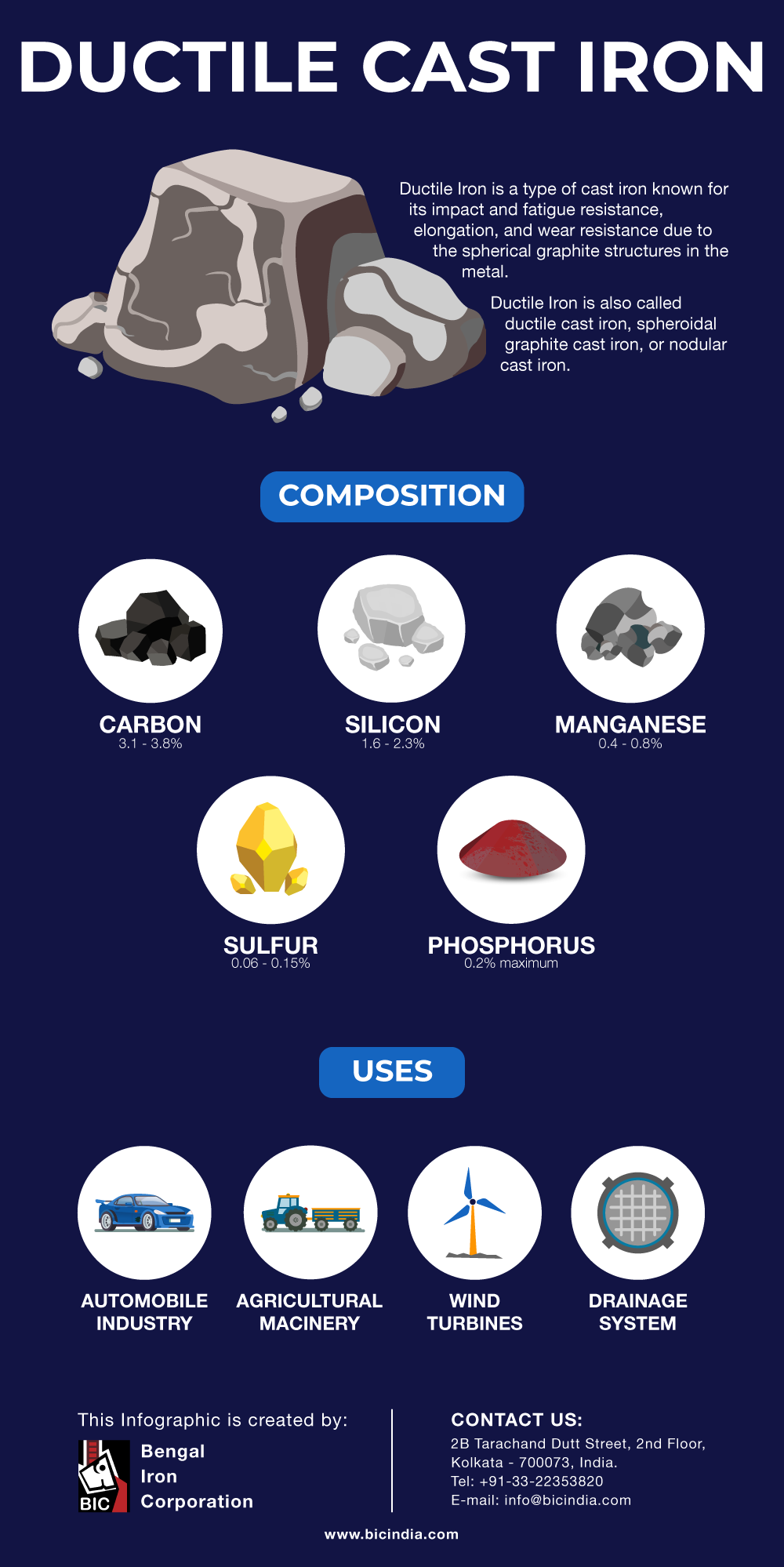
4 Strengths of Ductile Iron While Casting Manhole Covers

4 Strengths of Ductile Iron While Casting Manhole Covers

Are you worried about the material used in making manhole covers? Cast iron or steel it is important to note that both has its own facilities and benefits. While talking about manhole covers one need to understand that it is one of the most important aspect that have both hygienic and aesthetic values. To gather knowledge about the metals used by manufacturers and reasons of using the same, one needs to take an insight onto the details provided below!

It is important to note that one needs to know the strengths of metals. When it comes to ductile iron there are a lot of advantages added to it that makes it the only option. While you are interested in buying the best ductile iron manhole cover, they need to gather enough knowledge about ductile iron manhole covers manufacturers and buy the best that can satisfy the demand. Here’s a list of benefits that you can note to get while you use the same:

  1. Bendable yet unbreakable

Manufactured from materials like carbon, phosphorus, silicon, Sulphur, magnesium and more, this material are considered as the something that adds to the strength of the iron covers. Thus, making it a durable than the others in the field. Apart from this quality, one more which allures the users towards the metal is that these ductile irons are easily bendable without risk of breaking.

  1. Compressive strength

While talking about metals it is important to note that the compressive strength of that metal is taken into consideration. The term is best explained as the – pressure which a metal can withstand in order to change its shape. The ductile iron has a greater compressive strength compared to other similar metals that are also used to make manhole covers. Therefore, there are no better alternatives compared to Iron.

  1. Resistant to corrosion

Since manhole covers are exposed to natural elements like rain, frost, hail, sun and others it exhibits high risk of damage. But with a fresh coat of powder or polish the iron has no other alternatives that can support the cause. For example – steel when compared to corrosive effects rank higher and therefore, it is advisable to use cast iron as the most effective metal.

  1. Cost-effectiveness

The most important factor that one needs to consider while it comes to man hole cover construction is cost effectiveness. Iron compared to other metals cost less and therefore it becomes a known material among users. While cost effectiveness is one factor that consumers look into, there remains no suspicion that this metal qualifies as the best among others.

BIC Ductile Iron Pipes fittings

BIC is Now ISO Certified!

It is with immense pleasure and pride that we would like to announce that BIC is now ISO 9001:2015 certified in manufacturing & supplying Grey Cast Iron Castings such as Hubless Pipes & Fittings, Centrifugal Pipes & Fittings, Soil Pipes & Fittings, and Manhole Covers & Frames. We have been in the manufacturing business since 1965. Our reputation, our legacy and our very existing for all these years can be attributed to the top notch quality we maintain for all our castings. As a company we have been operational since before a time the ISO 9000 standard even existed. And today we are very proud to be associated with the British Standard Institute that has presented us with the ISO 9001:2015 Quality Management Certificate.

We have always prioritized quality for our customers. Our core value of quality consciousness exemplifies this. One of our missions this past year has been to be more process driven. The rationale behind this is to increase productivity, efficiency and use documentation to improve our traceability. The ISO 9000 quality management system provided us with just the right framework to be able to do this.

When we started working with our consultant, preparing a lot of the documentation that we usually didn’t, seemed like an uphill battle. Some of the tasks seemed excessive and sometimes unreasonable even. Initially, we were tempted to document just for the sake of the certificate. However, we felt that we are doing this to improve our internal systems and not just to tell the world that look we have a certificate. Consequently, as a team we decided going into this that we will do this properly. The entire process of getting ready for the audit and approval took about 3 months.

In these months, we realized that a lot of what we were doing presently was good, but there was room for improvement in certain processes. We identified HR & Maintenance as the ones that require the most work. As a result, we begun working on improving those systems and in these months we can see significant benefits. Employee engagement has increased considerably and machine downtime is on the downward trend. Even in other departments like purchase, production or sales, minor tweaks have made us more streamlined.

We are looking forward to continuing to adhere to our systems to stay compliant, ethical, efficient and highly productive.

Grey Cast Iron: Why it’s still important?

Grey cast iron belong to the oldest and most used materials for casting production. They have good foundry qualities and with continuous improvement of production technology they have achieved also suitable utility properties which have shown with increased of technical level and working reliability of castings.

grey-cast-iron_products_infographic


1.  Fire Safety: The prospects of fire in a building with PVC pipes can not only result in pipe repair but full replacement. That is because plastic can offer little to no protection in the presence of such heat. In contrast, cast iron pipes are fire resistant and can prevent the spread of fires. Another issue when it comes to fire is that when that plastic burns, it ends up emitting fumes that can be dangerous to breathe for anyone who unfortunately happens to be in the vicinity.

2.  Durability & Longevity: Compared to plastic, iron always has the upper hand when it comes to durability as well as longevity. Iron is denser and does not break or deform easily on rough handling as one sees in construction sites. Cast iron piping has been used successfully in plumbing systems for hundreds of years. In fact, in the year 1623 cast iron pipe was installed in the Fountains of Versailles in France. That same piping is still functioning today. Thousands of miles of municipal water and sewer systems use cast iron pipe. The reason is long-term durability. Cast iron simply lasts.

3.  Cost: Upfront although PVC products might be cheaper, the added cost of hanger spaces and expansion joints related to the pipes, the cost can exceed that of cast iron. Additionally, repairing cast iron sewer pipe is less frequent, which means that the money that might otherwise be invested in keeping them running can be used for other things.

4.  Noise Factor: One of the biggest complaints when it comes to PVC pipes is that the noise from them is much more pronounced than with cast iron models. In the latter case, the chief reason for the much quieter atmosphere is because of the thickness and density of the pipe involved, which offers a lot more serenity for a homeowner. That’s not something that will occur with PVC, where the running of a faucet, the turning on of a shower or the flushing of a toilet can be heard through the walls every time. That can quickly become an annoyance, especially for someone who plans on staying in their home for an extended period of time.

5.  Environmental Concerns: In order to minimize our environmental footprint, cast iron pipes would be the choice. The reasons are because PVC pipes are made with oil-based products and any PVC pipe repair usually discards the material into the trash. Meanwhile, cast iron pipes can be recreated from scrap iron.

Excessive noise and vibration are associated with equipment used in the mining, extraction, engineering equipments and processing of mineral resources. High vibration degrades structural components, often leading to huge economic failures and loss of productivity.

Grey iron has the ability to withstand thermal cycling well. Thermal cycling is where the component goes back and forth between warmer and colder temperatures. While thermal cycling can create stress and premature failure in some types of metal castings, grey iron has proven to endure the strain of thermal cycling quite well and not stress as easily.


References:

https://www.irbnet.de/daten/iconda/CIB_DC25341.pdf — Page 247

https://valsir-uneeq.co.za/EN/index_htm_files/MT_SCARICO_L02-345-1_GB.pdf — Table 2.8

Pattern Making Process

Development of patterns is the first step in the casting process. Patterns can be re-used to make more moulds and, if looked after, can last for many years making thousands of moulds.

For producing a mould or impression of desired shape in moulding sand, one needs to have a wooden or metallic pattern similar to the shape of the mould. The art and science of designing the pattern is called pattern making.

Common Metals that are used for creating patterns are –

  • Wood
  • Metal
  • Plaster
  • Plastic

Types of Pattern-Making Process

The type of patterns selected for a particular casting depends upon many factors such as type of moulding process, number and size of casting difficulty of moulding on account of design or typical shape of casting. The most common types of pattern are listed and described below:
(a) Solid or Single Piece Pattern
(b) Split Pattern
(c) Gated Pattern
(d) Sweep/Skeleton Pattern
(e) Match Plate Pattern

(a) Solid or Single Piece Pattern

The one piece or single pattern is the most inexpensive of all types of patterns. This type of pattern is used only in cases where the job is very simple and does not create any withdrawal problems. It is also used for application in very small-scale production or in prototype development. This type of pattern is expected to be entirely in the drag and one of the surface is is expected to be flat which is used as the parting plane. A gating system is made in the mold by cutting sand with the help of sand tools.

(b) Split Pattern

Split or two piece pattern is most widely used type of pattern for intricate castings. It is split along the parting surface, the position of which is determined by the shape of the casting. One half of the pattern is molded in drag and the other half in cope. The two halves of the pattern must be aligned properly by making use of the dowel pins, which are fitted, to the cope half of the pattern. These dowel pins match with the precisely made holes in the drag half of the pattern.

(c) Gated Pattern

Gated patterns are a group of patterns in which multiple castings are connected through a common gating system. In this type, runners and gates are integrated directly into the pattern, allowing molten metal to flow into several mould cavities simultaneously. This method increases production efficiency and reduces moulding time, making it highly suitable for mass production. Gated patterns are commonly used when producing small components in large quantities.

(d) Sweep/Skeleton Pattern

Sweep and skeleton patterns are used for producing large and symmetrical castings, where making a full solid pattern would be expensive and impractical.

A sweep pattern consists of a template (usually wooden) that is rotated around a central axis to generate the desired mould shape in sand. It is commonly used for circular or cylindrical shapes like pipes and tanks.

A skeleton pattern, on the other hand, is a framework that outlines the shape of the casting. The mould is formed by filling sand around the framework and finishing it manually. These patterns are economical and suitable for large castings produced in small quantities.

(e) Match Plate Pattern

Match plate patterns are used for high production work and are ideal for machine moulding processes. In this type, both halves of the split pattern are mounted on opposite sides of a single plate (called the match plate). The gating system, including runners and gates, is also attached to the plate.

This arrangement ensures accurate alignment of the cope and drag sections, reduces moulding time, and improves productivity. Match plate patterns are widely used in automated foundries for producing large numbers of identical castings with high precision.

How to install BIC Hubless Pipes & Fittings

This is a step-by-step guide for connecting BIC hubless pipe and fittings with BIC couplings. These suggestions are based upon accepted international industry standards and practices.

Important Points to Note

Ensure that the pipe ends have been cut straight and clean.
To prevent movement, pipes and fittings should be suitably braced by the use of blocks, rodding or other suitable methods wherever necessary.

Coupling Material

Coupling Shield: SS304
Rubber Gasket: EPDM

The Hubless Couplings gaskets are made of EPDM rubber conforming to IS 15905:2011. Chemical characteristics of EPDM assure that the gasket will not decay or deteriorate from contact with effluents in the pipe, or chemicals in the soil or air around the pipe.

BIC SS304 Coupling with EPDM Gasket

Joining Procedure

  1. Loosen screws, separate SS304 shield and EPDM rubber gasket.                                                     BIC Hubless
  2. Insert one spigot into the gasket and slip the shield over. Bengal Iron hubless pipes
  3. Insert spigots into the gasket from both sides and ensure they sit evenly and firmly on the rim inside. BIC Hubless Pipes
  4. Move the shield over the gasket and screw alternately to a tight fit. 

BIC Multiple Hubless

Defects in castings – Ductile & Grey Cast Iron

Defects during the casting process are not uncommon. Under practical conditions, all casting products contain voids, inclusions and other imperfections which contribute to a normal quality variation. Such imperfections begin to be regarded as true defects or flaws only when the satisfactory function or appearance of the product is in question: consideration must then be given to the possibility of salvage or, in more serious cases, to rejection and replacement.

Classification

The general origins of defects lie in three sectors:
1. the casting design,
2. the technique of manufacture–the method,
3. the application of the technique–‘workmanship’.

Standardization and optimisation of all aspects of the production technique offers the best way-out against such troubles. More specific precautions can be taken in those cases where there is a known susceptibility to a particular defect, whilst the radical approach of design modification may need to be considered in the extreme cases which do not respond to changes in foundry technique. It should be clear that any approach to the elimination of casting defects must be on an economic basis.

1. Shaping faults arising in pouring.
2. Inclusions and sand defects.
3. Gas defects.
4. Shrinkage defects due to volume contraction in the liquid state and during solidification.
5. Contraction defects occurring mainly or wholly after solidification.
6. Dimensional errors.
7. Compositional errors and segregation.

Significance of analysis of defects

Casting defects, whatever their cause, cannot be considered in isolation; their significance can only be established in relation to the function of the casting. Behaviour under service stresses and environment is in most cases the important reason behind the appearance.

What are the reasons of their occurrence? The first one is the
quality and the parameters of moulding and core mixtures. Number of the
defects was affected by temperature and humidity of ambient air, both in
store yards and in moulding mixture preparation shop. Consequently, it is
reflected in moisture content of silica sand and moulding mixture. This fact
can affect the quality of moulding and core mixtures and their prone to
disintegration by molten metal flow.
The second one is the presence of complicated design of the cavity in the mould,
containing thin walls, profiles, runners. From this fact follows the necessity
to design parameters of moulding mixtures from the mould complexity
point of view.
The third one is chemistry and pouring temperature of molten metal.
Viscosity of poured metal is extremely important.

India’s Perspective: Global Cast Iron Market

Amidst all the political uncertainties in Europe and US, the overall scenario of global cast iron market is growing in the positive direction. The US GDP growth rate is over 2% and that has increased consumption and demand of raw materials for infrastructure.

Grey cast iron is one of the most widely used castings and typically contains between 2.5% and 4% carbon, and between 1% and 3% silicon. The market potential of heavy grey iron castings is good and expected to be bright in future. These castings are required by sugar mills, general engineering works and mini-steel plants. The demand for such castings is increasing continuously due to rapid industrialization. Increased urbanization too is fueling the requirement for construction castings such as manhole covers, pipes and pipe fittings. Amidst all the political uncertainties in Europe and US, the overall scenario of global cast iron market is growing in the positive direction.

Export Quantity Value of Grey Iron is slowly growing after the Recession in 2008

Wide use of grey cast iron:

The versatile nature of cast iron makes it an excellent material for various companies to employ various moulding techniques and come up with a new range of products. The fluidity of liquid grey iron and its expansion during solidification is due to the presence of graphite. This property makes it ideal for the production of intricate castings. Shrinkage rate of grey cast iron is lesser as compared to ductile iron due to the percent of carbon content. With proper control of the carbon and silicon contents and the cooling rate, the formation of iron carbide during solidification is suppressed entirely, and graphite precipitates directly from the melt as irregular, generally elongated and curved flakes in an iron matrix saturated with carbon.

Quality attributes of grey cast iron in global cast iron market:

The presence of graphite flakes in the microstructure is responsible for its superior characteristics. It has more carbon content than the steel and therefore it has more than one microstructure. The higher carbon content of cast iron means that it solidifies as a heterogeneous alloy.

The iron & steel casting market is expanding steadily due to robust growth in construction and mining industries, especially in Southeast Asia and Eastern Europe. Increasing demand for iron & steel casting in automobile and electrical industries is anticipated to propel the growth of the market.

The development of state-of-the-art foundries was necessary to provide consistent, high quality castings. Castings from a highly automated Chinese foundry are 20% more expensive
than a hand foundry but are necessary for applications requiring repeatability and quality.

However, the recent changes in the labour and environmental laws in China accompanied with economic slowdown in US has compelled many small and medium scale businesses in US and Europe to import more from India. Poor air quality has forced the government to take a harder look at the industry as a contributor to pollution. This has led to an accelerating rate of iron ore mine closures in China. This has helped to improve the competitive edge of Indian foundries.

Having said that, Chinese manufacturers have the ability to respond to changes in demand with moderate‐to‐large changes in the quantity of shipments of cast iron fittings to the U.S. and Europe market. The main contributing factors to this degree of responsiveness of supply are the availability of unused capacity and inventories.

Traditionally, US and Europe markets are the largest importers of iron ore as well as cast iron and steel. However, there is a strong economic signal from the Middle East as well as from the ASEAN countries that has diversified the import market.

Germany, which is presently the 4th largest economy in the world, has a huge demand as their economy are growing at a good pace. They are considered to be the market leaders in high-end engineering goods so their OEM always look out for precision products with super-build quality.


Cast Iron: CI Composition, Properties and Products

Pig Iron is the intermediate iron product between smelting iron ore and usable cast iron products. Grey Cast iron (CI) is made when pig iron is re-melted in small cupola furnaces (similar to the blast furnace in design and operation) and poured into molds to make castings. Cast Iron is considered as an alloy of iron with greater than 2% carbon, and usually with more than 0.1% silicon and there are are 3 other important types of cast iron (CI products) apart from grey cast iron.

The presence of flake graphite in the silicon-iron matrix make grey iron castings a unique material. The presence of graphite, the distribution pattern and the length of the flakes determine the strength and quality of cast iron.

Primarily there are 4 types of cast iron –

  • Grey Cast Iron
  • Ductile Iron
  • Malleable Iron
  • White Cast Iron

We will discuss more about Grey Cast Iron here –

In gray iron, slower solidification produces a larger graphite flake size. A slower cooling of the casting will produce a lower hardness in the metallic matrix.

  • Fatigue properties
  • Damping properties

The properties of grey iron can be determined by the amount of additional elements in the grey iron :

Cast iron contains small percentages of silicon, sulphur, manganese and phosphorus. The effect of these additional elements on the cast iron are as follows:

  1. Silicon: About 3% of silicon can be present in cast iron. It provides the formation of free graphite which makes the iron soft and easily machinable.
  2. Manganese: It makes the cast iron white and hard. It is often kept below 0.75%. It helps to exert a controlling influence over the harmful effect of sulphur.
  3. Phosphorus: It aids fusibility and fluidity in cast iron, but induces brittleness. It is rarely allowed to exceed 1%. Phosphoric irons are useful for casting of intricate design and for many light engineering castings when cheapness is essential.

Cast Iron Products: Quality Control and Management

Quality control methodology has undergone a long period of change, involving a broadening of the subject to enhance many more aspects of the production process and product than were traditionally considered. These changes have had major effects in the field of internal management organization, as well as in the commercial relationships involved in the procurement of castings.

Casting defects can negatively impact the profit margin of the company. There are instances such as rework costs or casting scrap costs that not only affect financial state of the company but also affect customer services. However, in many cases, the casting defects may appear at the machining stage, at the assembly stage or during use of the component. The resultant value added costs and warranty costs may sometimes be passed on to the foundry by their customers.

Let’s take a look at the kind of defects and how they can be identified.

Tests for defects in the surface zone

Cracks and other flaws communicating directly with the surface of the casting can be detected using techniques including penetrant methods, chemical etching and oil and chalk testing. The penetrant methods are based on the use of fluids to permeate and highlight defects by increasing their contrast and are helpful in establishing the soundness and integrity of thin walled castings in cases where pressure testing is difficult to execute. If there is any seepage, then it can be easily observed.

Dye penetrant testing

The surface of the casting is treated with a dye solution based on a low viscosity solvent which is applied by brush or aerosol spray or the casting can be entirely immersed in a tank of solution; the casting is then thoroughly rinsed and dried. After a time, seepage of residual fluid occurs from cracks and other narrow surface defects to produce a visible stain.

Oil and chalk testing

This long established technique uses paraffin oil as the medium. The casting is treated, usually by immersion, with heated paraffin; it is then rinsed in detergent solution and water and dried. Using a low pressure air dispenser the surface is coated with dry powdered chalk, which becomes marked after a time by seepage of paraffin from cracks or porous zones.

Chemical etching

Very fine surface cracks and similar defects may be masked by a thin layer of metal resulting from superficial plastic deformation. This can occur in shot blasting, in fettling or even in the machining of a casting. The masking layer may consist of oxide scale formed in heat treatment.

A simple analysis of casting defects

For the characteristic criterion of quality level measuring, it is assumed quantity of defects in one year. The first step of analysis is the assessment of process by means of Ishikawa’s diagram. Ishikawa’s diagram – diagram of cause and effect, or “fish bone” diagram – makes possible identification of sources of problems formation, helps quality a sequence of causes and makes easy problem solution (SIEKANSKI K. 2002).

Ishikawa Diagram_BIC

Fig. 10.1 Part of Ishikawa´s diagram for problem of non-conformances formations in process of casting products.

Source: https://tulip.co/blog/lean-manufacturing/fishbone-ishikawa-diagram-for-root-cause-analysis/

BIC at Engineer Training Programme on Cast Iron Soil Pipes and Fittings

December 28, 2018, was a special day for BIC. Our North India Sales Head, Mr Gaurav Gupta, had the honour of being invited by the Department of Water Supply & Sanitation, Punjab to educate newly appointed Junior Engineers (JEs) on the uses as well as quality standards of cast iron soil pipes and fittings.

BIC Training Event

The induction training programme was attended by 180 JEs along with veteran Executive Engineers and Chief Engineers. Gaurav’s lecture focussed mainly on what engineers should look out for when selecting and evaluating cast iron soil pipes and fittings as per IS 1729:2002. The considerations of quality, designs, special use cases and manufacturing techniques were brought to light. One of the most interesting points that was discussed was the importance of deep as well as shallow seals in Nahani Traps and P-Traps. The design of these seals is imperative in preventing foul odour, keeping away pests and avoiding clogged toilets.

BIC Punjab Traning

BIC has a legacy of being the premier supplier of this range of cast iron pipes and fittings. It is our focus on maintaining these design considerations and quality standards that have enabled us to be a market leader in IS 1729:2002 products. We are proud to be exporting these items to various countries across the globe as well.

Mr Gaurav Gupta at BIC

Training the new generation of engineers who serve the Government of India is truly an honour for us and we hope to play our part in the development of the country.

Enquire Now

Get In Touch
×
Best Cast Iron Supplier Top Ductile Iron Manufacturer