


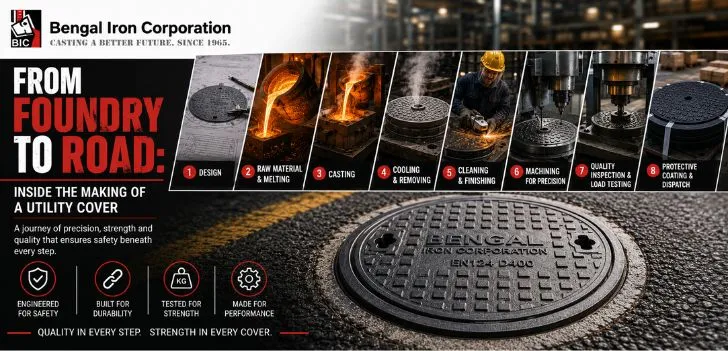
Have you ever walked over a utility cover without giving it a second thought? Most of us have. Yet beneath every durable cover lies a remarkable manufacturing journey that combines engineering, precision, and quality control. Utility covers play a critical role in protecting underground networks, including drainage systems, water pipelines, electrical cables, and communication lines. Hence, they must withstand heavy traffic, harsh weather, and years of continuous use.
Many buyers focus only on the cast iron chamber cover price, but the manufacturing process is what truly determines the product’s quality and lifespan. That is why every stage of the production matters. From selecting raw materials to conducting final quality checks, manufacturers follow a carefully planned process to ensure every cover performs safely on the road. In this blog, we will highlight the major steps included in manufacturing a utility cover.
How a Utility Cover Transforms from Raw Material to Road-Ready Infrastructure
In the segment below, we will explore how a recessed manhole cover in India moves through every stage of manufacturing, from raw materials to a reliable road-ready structure.
Designing the Utility Cover
The first notable step in making a utility cover is deciding its design. First, engineers determine the size, load-bearing capacity, locking mechanism, surface pattern, and application. A cover designed for a residential footpath differs greatly from one meant for busy highways or industrial zones. Every design follows relevant industry standards to ensure safety and durability.
Selecting High-Quality Raw Materials
The next step in making a utility cover is to select high-quality raw materials. The strength of a utility cover begins with its raw materials. Manufacturers always choose premium-grade iron and other required alloys to achieve the desired mechanical properties. Selecting high-quality materials improves resistance to corrosion, impact, and long-term wear, making the finished product dependable under demanding conditions.
Melting and Casting
Once the raw materials are ready, the workers melt them in high-temperature furnaces. The molten metal is then carefully positioned into prepared moulds that match the required design. This casting stage demands exceptional precision because even small defects can affect the strength and performance of the final product.
Cooling and Removing the Casting
After pouring, the molten metal is allowed to cool naturally until it solidifies. The newly formed casting is then removed from the mould. Skilled workers inspect the casting visually before moving it to the next production stage.
Cleaning and Finishing
Freshly cast utility covers often have excess metal, rough edges, and surface impurities. These imperfections are removed through grinding, shot blasting, and surface finishing. This step improves both appearance and structural integrity while preparing the cover for further inspection.
Machining for Precision
Many of us are unaware that certain utility covers require machining to achieve accurate dimensions and a perfect fit. Precision machining ensures that the cover sits securely within its frame, reducing movement, noise, and unnecessary wear after installation.
Quality Inspection and Load Testing
This is one of the most critical stages of the manufacturing process. Each utility cover undergoes strict quality inspections, dimensional checks, and load tests to verify its strength and reliability. Only products that meet established quality standards move forward for dispatch.
Protective Coating and Dispatch
Finally, manufacturers apply protective coatings to enhance corrosion resistance and extend service life. After packaging and final verification, the utility covers are shipped to infrastructure projects, municipalities, construction companies, and industrial sites, ready to serve for decades.
The Conclusion
So, every utility cover tells a story of engineering expertise, skilled craftsmanship, and rigorous quality control. From the first design sketch to the final installation on roads, each manufacturing stage contributes to creating a product that protects vital underground infrastructure while ensuring public safety.
If you are looking for premium-quality utility covers manufactured with precision, durability, and uncompromising quality standards, Bengal Iron Corporation can be your trusted partner. With years of manufacturing excellence and a commitment to superior engineering, Bengal Iron Corporation delivers reliable utility cover solutions that stand the test of time. So search for the term ‘manhole cover near me’ and get in touch today, and invest in products built for performance, safety, and lasting value.


